
Chapter I · Bida
A town of craftsmen.
Brass, glass, cloth and clay, from a walled city on the Niger floodplain, nine minutes from where you will be sleeping.
- c. 1531
- Taken by Tsoede
- 1850s
- The red wall begun
- 13 km²
- Enclosed by it
- 2021
- UNESCO Creative City
Movement 01 · The place
The floodplain decided everything.
Two rivers, a tributary too small to name on most maps, and a belt of land where the savannah gives way to the Sahel. Every craft this town is known for comes out of that geography.
Bida sits in the middle of Nigeria, in the country held between the Niger and the Kaduna: a low valley interrupted here and there by flat-topped plateaus rising straight out of the plain. The town itself is not on either great river. It is on the Bako, a minor tributary you could wade across in the dry season, at the point where the roads from Jebba, Zungeru and Agaie happen to cross.
That is the whole explanation. The two rivers were the region's road system for centuries, carrying goods from the northern savannah down to the southern forests and back. Bida sat inland of both, at a junction, close enough to reach the water and far enough to be defensible. Everything else followed.
The land gave the materials. Clay from the floodplain for pots and for the walls of the compounds. Reeds and cane from the riverbanks for mats and baskets. Sand for glass. Cotton in the fields alongside the millet, sorghum, yams and rice. Timber from the wooded edges. None of it had to be imported, and all of it arrives seasonally, which is why the kilns fire when they fire and the looms fall quiet when the rain comes.
The Nupe are not one undifferentiated people, and the geography accounts for that too. Of the closely related groups, the Beni, the Zam, the Batache and the Kede, it is the Kede and Batache who are river people who have always lived by fishing and trading on the water. The rest are farmers. Bida was originally a small Beni settlement, and it is Beni country still.
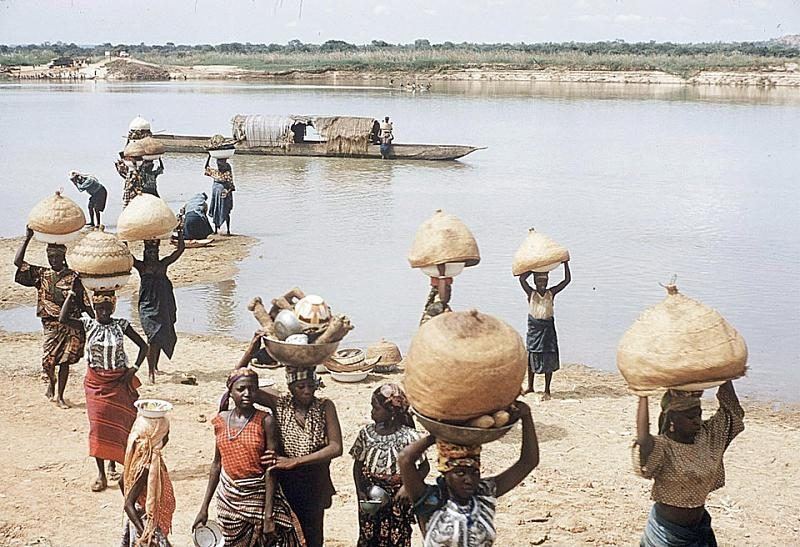
It matters because the river groups moved. Nupe brass and Nupe cloth travelled north to the Hausa cities and south to Yorubaland and to Benin, and they travelled on Kede canoes. What the town produced, the river distributed. The photograph below is the whole economy in one frame.
Movement 03 · Life then
A capital moved, a wall raised, an empire lost.
Bida became the Nupe capital by winning a civil war. Forty years later it lost everything to a trading company with artillery. Both facts are still visible in the town.
Before any of this, Bida was a small Beni village. Around 1531 it was taken by Tsoede, also called Edegi, who united the Nupe clans and became the first etsu Nupe, king of the Nupe people. He is the founding figure of the whole story, and he belongs to the next chapter, because what he founded was a people rather than this particular town.
Bida's own moment came three centuries later, and it came out of a fight. The Nupe kingdom had been conquered by Fulani forces around 1806 and absorbed into the Sokoto empire as an emirate. In 1835 Usman Zaki proclaimed himself etsu Nupe. A rival Fulani emir, Umar Bahaushe, contested it, and the Nupe civil war ran from 1847 to 1856. Usman Zaki won it at Bida, and so Bida replaced Raba, sixty-seven miles west, as the capital.
Then came the wall. Begun in the 1850s, built of the red clay the floodplain provides, it eventually enclosed five square miles of town. It is still there. If you walk the circuit in the early morning you are walking the outline of a nineteenth-century capital, and the modern town has spilled well past it.
- c. 1531
- Tsoede takes Bida, then a small Beni settlement, and founds the Nupe kingdom.
- c. 1806
- Fulani forces conquer the kingdom. Its centre becomes the Nupe emirate within the Fulani empire.
- 1835
- Usman Zaki proclaims himself etsu Nupe.
- 1847–56
- The Nupe civil war. Usman Zaki defeats Umar Bahaushe at Bida, and moves the capital here from Raba.
- 1850s
- The town wall is begun. It will enclose 13 square kilometres.
- 1859–73
- Under Emir Masaba, Nupe becomes the most powerful kingdom in central Nigeria. Three royal palaces, the night market and the central mosque are built.
- 1871
- Trade relations opened with the Royal Niger Company.
- 1897
- Disputes over trade and slave dealing end in a British campaign. The Fulani army is defeated at Bida.
- 1901
- British occupation of the town.
- 2003
- Alhaji Yahaya Abubakar becomes Etsu Nupe. The emirate remains a respected traditional authority; political power sits with the state and federal governments.
Masaba's reign is the high point, and the reason so much of the old town is worth looking at: three palaces, a central mosque, and a night market; a market that opened after dark, in a town whose economy ran on things made by hand during the day.
The end came from the river. The Royal Niger Company established trade with Nupe in 1871; by 1897, arguments over trade terms and over slave dealing had turned into a military campaign, and the Fulani army was beaten at Bida. Occupation followed in 1901. The town went from the capital of the most powerful kingdom in the region to an administrative district in the space of one man's working life.
Movement 03 · Life then
The workshop was never a separate building.
It was the part of the house that was working that day. Understand that and you understand why Bida's crafts survived when factory competition killed the same trades elsewhere.
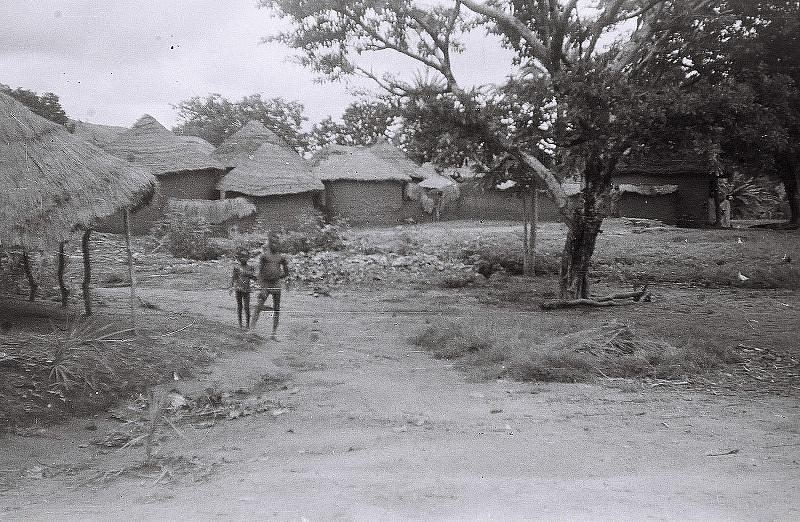
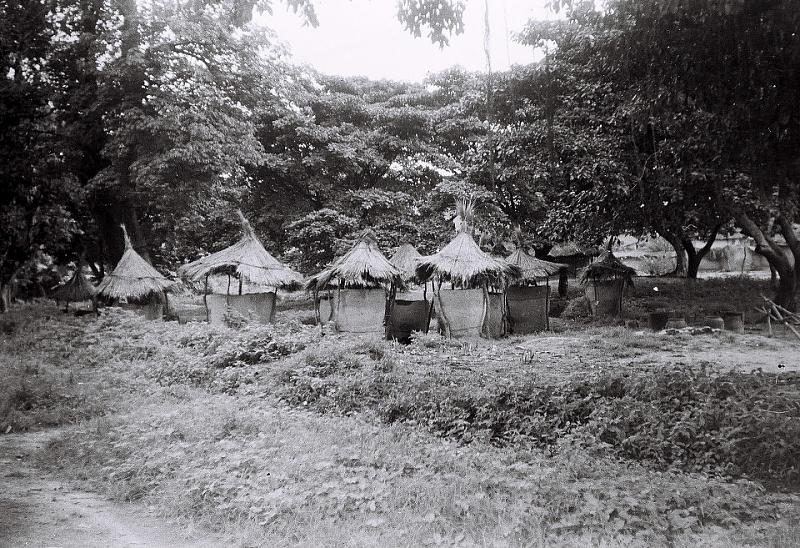
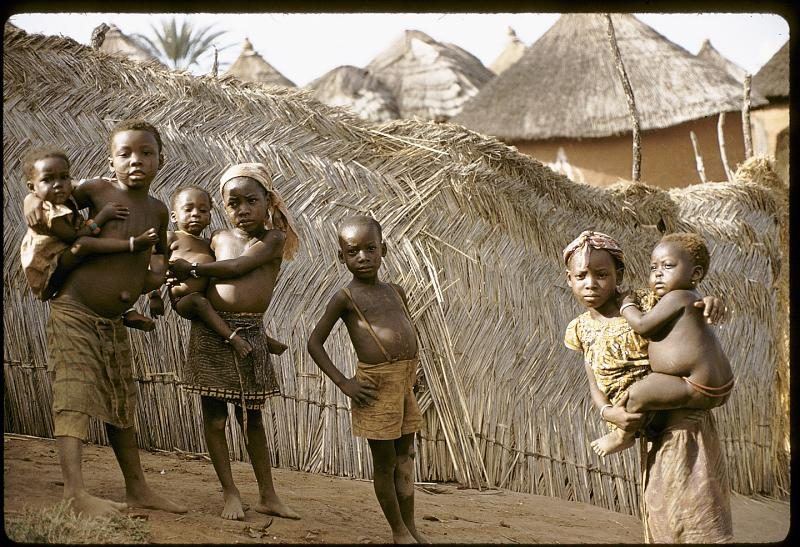
A Bida compound held a family and its trade behind the same walls. The furnace was in the yard. The loom was in the passageway. Children learned by carrying: charcoal to the fire, water from the well, finished work to the market. By the time they were old enough to be useful they had watched the whole process several thousand times.
The trades were organised into guilds, and the guilds were organised into wards, so a whole quarter of the town might be brass. Membership was largely hereditary and largely male. There is one significant exception, and it is worth naming: cloth weaving. Nupe women wove, and they wove inside the compound passageways rather than in a guild workshop, which is a different economy operating in the same building.
What Nadel called it
A Black Byzantium
S. F. Nadel's 1942 study of the Nupe kingdom; still the standard ethnography, and the source most later writing on Bida rests on
Nadel's title was not decoration. He was describing a state with a court, a bureaucracy, a professional army, tributary provinces and a guild economy: the apparatus of an empire, on the Niger, documented in the 1930s while much of it was still running.
What the compounds produced was not folk art. It was manufacturing: brass bowls, trays and ceremonial regalia; glass beads and bangles; embroidered gowns and caps; carved stools; mats and cane work; pottery; terracotta tiles and moulded decoration for the façades of houses. The town exported rice, kola, smoked fish, shea butter and groundnuts alongside all of it.
The river did the rest. Kede canoes carried Bida brass to Hausa markets in the north and to Yoruba and Benin markets in the south; salt, palm oil, livestock and eventually European glass came back the other way. A tray cast in a compound yard could end up eight hundred kilometres away without anyone from that compound ever leaving the floodplain.
Movement 05 · Life now
Wednesday, and the furnaces are lit.
Some of this survived and some of it did not. We would rather tell you which is which than sell you a town frozen in the 1950s.
In 2021 Bida was designated a UNESCO Creative City of Crafts and Folk Art, the first Nigerian city to join that network. The citation lists glass production, metallurgy, wood carving, fabric and raffia weaving, and notes that the artisans still work with traditional furnaces and hand-made tools. It is a real distinction and it is also, read carefully, an argument about survival.
What is thriving: brass and aluminium smithing, which adapted when aluminium became cheap and never looked back. Glass beads and bangles, still made by the same hereditary guild. Embroidery. Mat and cane weaving. Terracotta and moulded façade work.
What is thinner than it was: the cloth. Nupe women's weaving, the marriage cloths and the elaborate red wrappers made in compound passageways, has declined since the middle of the twentieth century. It has not disappeared, and the ceremonial cloths still matter enormously, but imported fabric took the everyday market. Printed cotton is now worn alongside the indigenous textiles rather than instead of them.
And one thing is genuinely close to lost. The Masagá glassmakers, who held the formula for their own raw glass for nearly two centuries, largely stopped making it: the raw materials became too expensive and too hard to source, and recycled bottle glass does the job. That story belongs to the next chapter, and it is the sharpest thing in it.
The brass market still opens on a Wednesday, in the same place it has been. Several stalls are held by the fourth or fifth generation of the same family. What has changed is who buys: a tray that once went north by canoe now goes to Lagos by lorry, or into a corridor nine minutes from where it was cast.
Still made here
- Brass & aluminium
- Glass beads
- Weaving
- Embroidery
- Pottery
- Mat & cane
- Wood carving
- Dyeing
Eight of the trades named in Bida's UNESCO citation, drawn in the brand's own cultural glyph set. They are editorial marks and never appear inside a button.
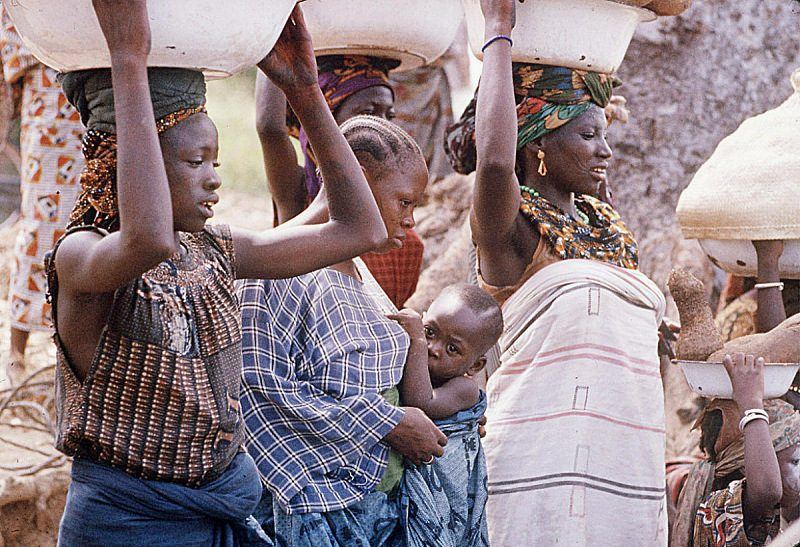
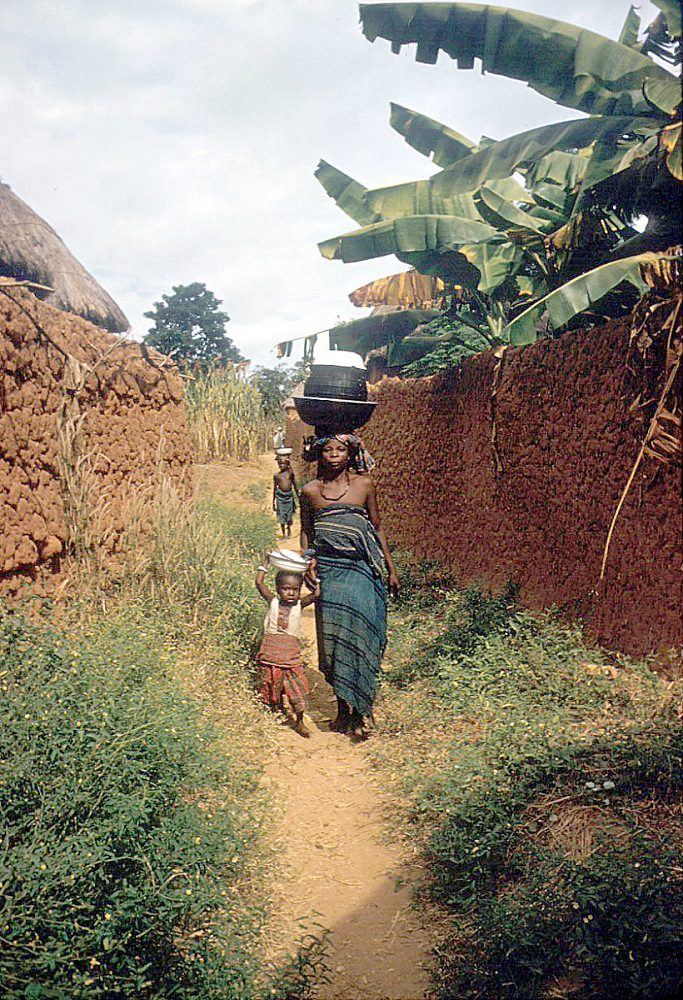
A note on the archival photographs. The images in these galleries are held by the Eliot Elisofon Photographic Archives at the National Museum of African Art, Smithsonian Institution. The collection requires that permission to reproduce is obtained in advance, and it remains subject to copyright. We have not recreated, redrawn or generated any of them.
Sources
- S. F. Nadel, A Black Byzantium: The Kingdom of Nupe in Nigeria (Oxford University Press, 1942). The standard ethnography of the kingdom and its guild economy.
- Eliot Elisofon Field Collection, EEPA 1973-001, Eliot Elisofon Photographic Archives, National Museum of African Art, Smithsonian Institution. The photographs in these galleries.
- Encyclopædia Britannica, "Bida". The dynastic and colonial chronology, the town wall, and Masaba's building programme.
- UNESCO Creative Cities Network. Bida's 2021 designation as a City of Crafts and Folk Art.
- H. Vernon-Jackson, "Craft Work in Bida," Africa: Journal of the International African Institute 30(1), 1960.
- Judith Perani, "Patronage and Nupe Craft Industries," African Arts 13(3), 1980.
- House 7 Hotels & Resorts. Contemporary photography of the brass workshops and the property.
The brass in the corridor was cast nine minutes from your room.
Send us a message on WhatsApp and a person at the front desk replies.
Reserve a room